
The Savage Device
A SWADE Puzzle Mini Game Mechanic

The Concept
Sometimes a skill check is not enough and you want a more complex puzzle for your players to solve. This mechanic is inspired by the pipe puzzles from Bioshock. This Mechanic can use the Action Deck to make a physical mini game out of solving a complex mechanical task.
A caveat to this mechanic: This is a mechanic that makes the PLAYERS feel smart and it takes the focus of brilliance off the character. This kind of shift from skill check to mini game can be a great change of pace but it is not necessarily going to be to everyone’s taste. Make sure you check with your players before introducing this kind of mechanic.
The Mechanic
When to Use these Rules: This is a way to generate a quick pattern matching puzzle to challenge your players. Could emulate hacking, or lockpicking or some other mechanical puzzle a player encounters. It could even be used to emulate navigating complex magical patterns for major works of magic.
The Basics:
Board set up: Lay out randomly drawn cards in a 5x5 Grid from either the Action deck or a secondary deck if you have one. Place a token on the center card.
Movement rules: Token can move a direction based on the suit of the card it is on.
♦️ Diamond: Down
♥️ Heart: Up
♠️ Spade: Left
♣️ Club: Right
Jokers allow movement in any direction and as normal for when a Joker is dealt, it gives everyone a benny.
I recommend having this written somewhere that the players can reference.
End Point: GM places a second token on an edge card to be the end point. Alternately the goal can simply be to move off the edge of the Grid in any direction.
Player Move: Swap the position of two cards (not including the center card) to make a path to the end point. The Player can perform up to 3 swaps. A Benny can be spent to re-deal the grid. The End Point remains in the same location on the grid however.
Scaling the difficulty:
The easiest method to adjust the difficulty is simply by where you place the end point. If you choose to not have one at all it makes the task almost trivial with 3 swaps. Having no set endpoint is good for first timers to get used to the format, however.
End Point placement can be made more or less difficult based on how the cards are dealt. GMs may want to practice this a few times on their own to get a feel for the puzzle so they know where to place the end point
Additionally once one is comfortable with a 5x5 grid you can scale it up to 7x7. Obviously you should use a specific deck of cards for this. Additionally, you will want to increase the player swap count to 4.
If you wish to add complications to the grid you can flip a card or 2 over and have that card be a block that has to be moved around.
Consequences of failure:
Similar to a dramatic task, this is best used if there is a consequence to failure. Here are some options for that.
Damage or Fatigue - Either from electrical shock, a whirring gear, or magical feedback.
The Alarm - Failure to solve it causes an alarm and summons enemies.
Forever Gone - The puzzle locks and breaks and whatever was behind it, is lost.
Damaged Equipment - Maybe lockpicks break, a cyberdeck is damaged, a magical device is drained of its magic.
Example
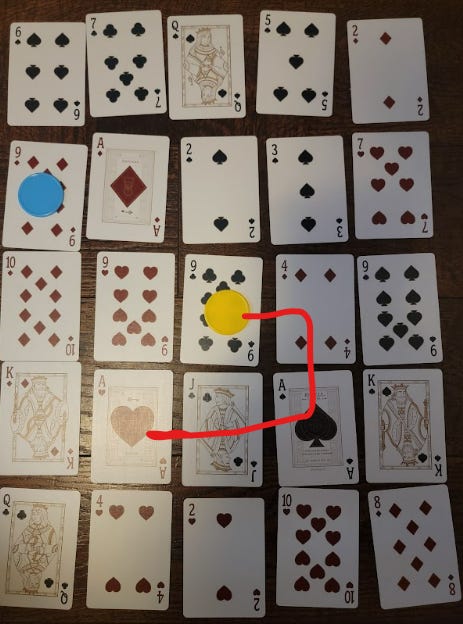
Here is a quick visual to help illustrate the system. Below the grid is laid out. The path ends at the Ace of Hearts where it pushes back to the Jack of clubs which gets the route in a loop and ending it.
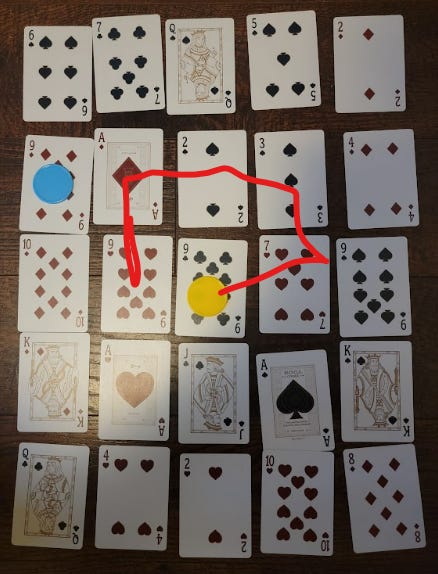
The first swap is to change the route at the first card past the center. I swapped the 4 of diamonds with the 7 of hearts. This opened up a route to the ace of diamonds just short of the goal.
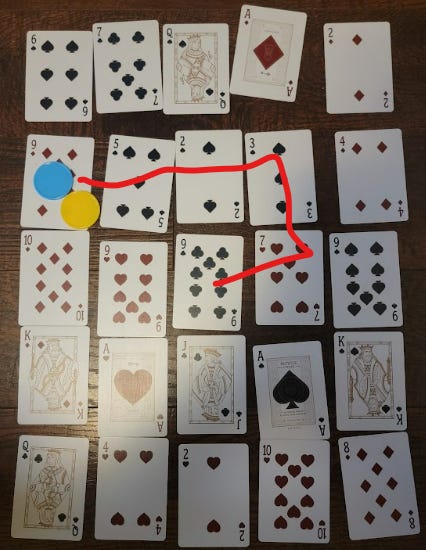
So the next swap is to move the Ace of diamonds with a spade and grabbed the five to swap with the ace completing the route.
Hope people find this interesting! If you have thoughts or have tried to use this in your game let me know in the comments!